Supplement Guides
Do Creatine Gummies Work? Science vs. Hype (2026 Guide)
Key Takeaways
Here’s what matters most if you’re short on time:
Creatine works the same in any format
Creatine monohydrate saturates muscle the same way whether it arrives in a scoop or a gummy. The molecule does not change shape on the way down.
Most creatine gummies are underdosed
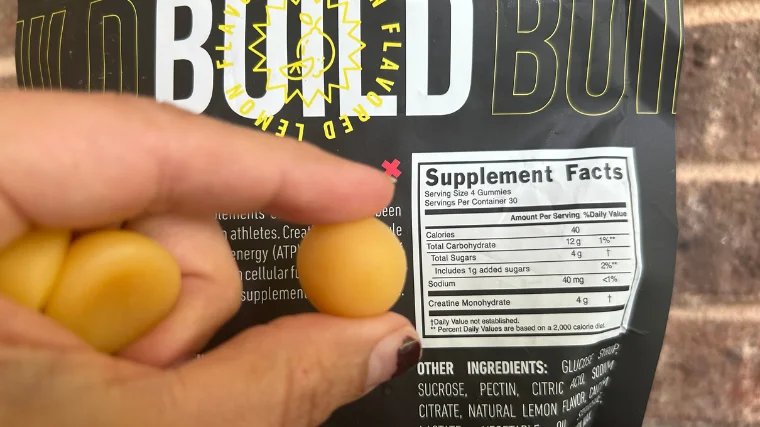
Many brands deliver 1 to 2 g per serving, so you may need several pieces to reach the studied 3 to 5 g a day. Divide 5,000 mg by the creatine per gummy before you buy.
Independent lab testing is the real filter
In 2024 and 2025, third-party testing found several creatine gummy products well below their label claims. Look for dated, batch-level results on the finished product.
Watch the form, the sugar and the panel
Creatine monohydrate, a printed mg-per-gummy figure, no proprietary blends, and a sugar load you are happy to eat daily.
Creatine gummies are everywhere in 2026. They’re on TikTok, in gym bags, on office desks, and tucked into carry-on luggage. And with that kind of visibility comes a very fair question: do creatine gummies actually work?
If you’ve been taking creatine powder for years, you might look at a gummy and think it’s a marketing gimmick – a candy dressed up as a supplement. And honestly, that skepticism isn’t entirely wrong. A lot of creatine gummies on the market are underdosed, sugar-loaded, and more about aesthetics than actual results.
But here’s the thing: creatine is creatine. The molecule doesn’t change because it’s in a gummy instead of a powder. What does matter is whether you’re getting enough of it – and whether the form you’ve chosen is one you’ll actually take every single day.
This guide breaks down the real science behind creatine gummies, compares them head-to-head with powder and pills, addresses the honest limitations, and helps you figure out whether they’re the right choice for your body and your routine. No hype. No fluff. Just evidence.
How Creatine Works (30-Second Science)
Creatine is one of the most studied supplements in history – and one of the simplest to understand.
Your muscles use a molecule called ATP (adenosine triphosphate) for energy. Every time you lift a weight, sprint, or do a burpee, your body burns through ATP fast. The problem: your ATP stores are tiny. They run out in seconds.
That’s where creatine comes in. Your body stores creatine as phosphocreatine in muscle tissue. When ATP runs out, phosphocreatine donates a phosphate group to regenerate it. More creatine in your muscles = more ATP recycled = more reps, more power, faster recovery between sets.
The research is clear: 3 to 5 grams of creatine monohydrate per day is the proven effective range, confirmed across hundreds of peer-reviewed studies spanning more than three decades. Daily doses of 3 to 5g saturate muscle stores within about 3 to 4 weeks (Antonio et al., 2021).
Here’s the part most people miss: the delivery format does not change the biochemistry. Your digestive system breaks down whatever you consume – powder, capsule, gummy – into the same creatine molecules that enter your bloodstream. Your stomach doesn’t know the difference. Your muscles certainly don’t.
The only question that matters is: are you getting 3 to 5 grams of creatine monohydrate per day, consistently? For the basics, see our guide to creatine for women.
Do Creatine Gummies Work as Well as Powder?
The honest answer: yes – if the dose is right.
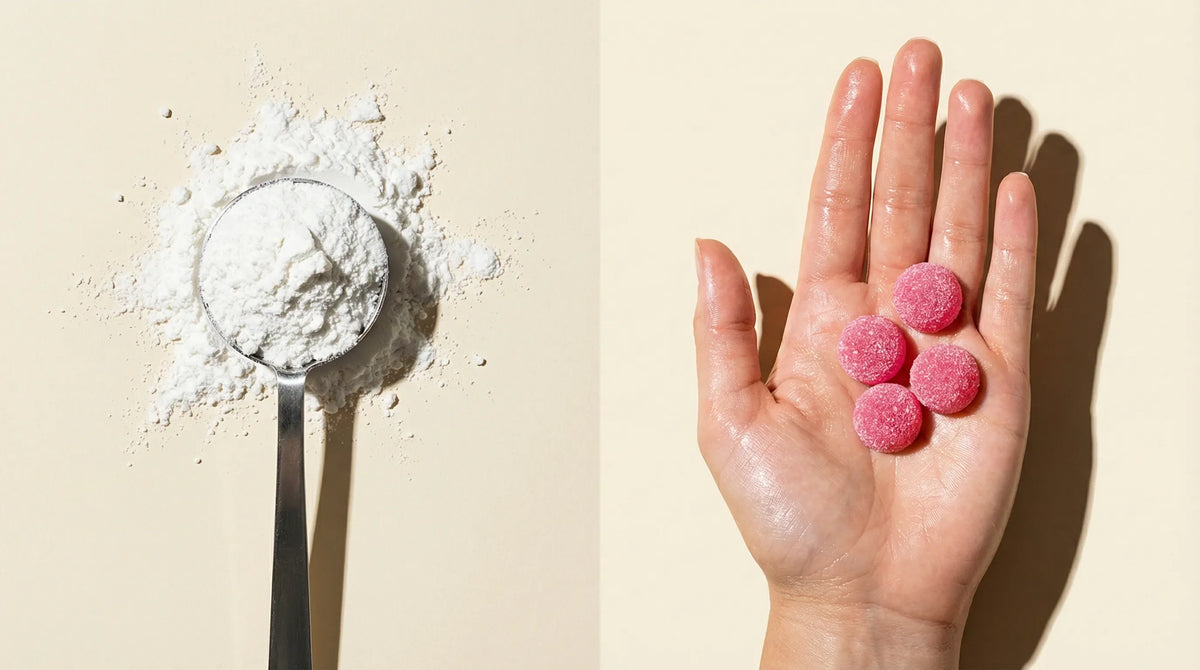
Creatine monohydrate is creatine monohydrate. Whether it arrives in your stomach via a scoop of white powder mixed into water, a capsule you swallow, or a gummy you chew, the end result is the same molecule being absorbed through the same digestive pathway. Once it’s in your bloodstream, your body can’t tell the difference.
This isn’t a matter of opinion. It’s basic biochemistry. The International Society of Sports Nutrition (ISSN) published a comprehensive position stand on creatine supplementation (Kreider et al., 2017) confirming that creatine monohydrate is the most effective ergogenic nutritional supplement for increasing high-intensity exercise capacity and lean body mass. Their conclusions say nothing about format – because format is irrelevant once absorption occurs.
So why do some people claim creatine gummies vs powder is even a debate? Because of one critical variable: dose.
Most creatine gummy brands on the market deliver between 1 and 2 grams per serving. That’s 20-40% of the clinically effective dose. At that level, you’re essentially paying for a creatine-flavored candy. Your muscles won’t reach full saturation, and you won’t see the performance benefits the research promises.
But a creatine gummy that delivers a full 5 grams of creatine monohydrate per serving is biochemically identical to 5 grams of powder. Full stop. The gummy is just the vehicle. The creatine is the active ingredient.
Think of it this way: caffeine works whether it comes from a coffee, an espresso shot, or a caffeinated gummy. Nobody questions whether caffeine gummies “work” as long as they contain enough caffeine. The same logic applies to creatine.
The format debate is a distraction. The dose is everything.
The Real Problem with Most Creatine Gummies
If creatine gummies work the same as powder at equal doses, why do they have a bad reputation? Because most of them are doing it wrong.
Here’s what to watch out for:
Underdosing
This is the biggest issue by far. The majority of creatine gummy brands use just 1 to 1.5 grams of creatine per serving. Some even go as low as 750 milligrams. At those levels, you’d need to eat 4 to 7 gummies just to approach the minimum effective dose – and the brand’s label tells you to take 2. They know you won’t get results. They’re banking on the fact that you won’t check the math.
Wrong Form of Creatine
Some brands use creatine HCL (hydrochloride) instead of creatine monohydrate. Creatine HCL is often marketed as “more soluble” or “better absorbed,” but it has significantly less research backing it. The vast majority of clinical evidence – hundreds of studies – is based on creatine monohydrate. If a brand uses HCL, they’re making claims the science hasn’t fully validated.
Excessive Sugar
Gummies need a base, and for many brands, that base is sugar. Some creatine gummies contain 3 to 5 grams of added sugar per serving. When you’re taking multiple gummies per day to hit your dose, that sugar adds up. It’s not a dealbreaker, but it’s something to be aware of.
Proprietary Blends
If a supplement facts panel lists a “proprietary blend” that includes creatine alongside other ingredients, you have no way of knowing how much creatine is actually in the product. This is a red flag. Transparent brands list the exact amount of creatine monohydrate per serving on the label.
How to Spot a Good Creatine Gummy
Look for these non-negotiables:
- Creatine monohydrate (not HCL or other variants)
- 3 to 5 grams per day clearly stated on the label
- Third-party testing (Eurofins, NSF, Informed Sport)
- Low or no added sugar
- No proprietary blends – full ingredient transparency
What Lab Tests Found in 2024 and 2025
The biggest risk with a creatine gummy is not the format. It is whether the creatine is really inside. Creatine is stable as a dry powder, but in water it slowly turns into creatinine, a breakdown product, and this happens faster with heat and acidity (Kreider et al., 2017). Gummies contain water and acid, so manufacturing and storage matter.
In 2024, NOW Foods had 12 creatine gummy products lab-tested and found 5 with little to no creatine; the failing products contained creatinine instead (SupplySide Supplement Journal). In 2025, SuppCo reported that 4 of the 6 best-selling gummies it tested failed on identity and potency (SuppCo).
The lesson: check for an independent lab result before you buy. Reputable gummies are tested by an independent lab such as Eurofins at several dates after production, and you should be able to see the lab results yourself.
Creatine Gummies vs Powder vs Pills – Full Comparison
Choosing between creatine formats isn’t about which one “works better” – they all deliver the same molecule. It’s about which one fits your life well enough that you’ll actually take it every day for months.
Here’s the full breakdown:
| Factor | Creatine Gummies | Creatine Powder | Creatine Capsules/Pills |
|---|---|---|---|
| Effectiveness | Equal (at 5g dose) | Equal (at 5g dose) | Equal (at 5g dose) |
| Absorption | Equal (same molecule) | Equal (same molecule) | Equal (same molecule) |
| Convenience | High – no water, no mixing | Low – needs water, shaker, measuring | Moderate – needs water to swallow |
| Taste | Excellent – flavored | Neutral to gritty (unflavored) or artificial (flavored) | None (swallowed whole) |
| Bloating | Uncommon at 3 to 5g a day | Uncommon at 3 to 5g a day (more likely with loading) | Uncommon at 3 to 5g a day |
| Portability | Excellent – toss in a bag | Poor – bulky container, spill risk | Good – bottle or pill case |
| Cost per Serving | Higher (~$1.00-1.50) | Lowest (~$0.30-0.50) | Moderate (~$0.50-0.80) |
| Daily Compliance | Highest – enjoyable ritual | Lowest – friction, forgetting | Moderate |
| Pills/Scoops Needed | 2-4 gummies (brand-dependent) | 1 scoop | 4-8 capsules for 5g |
The Compliance Factor
Here’s what the comparison table doesn’t fully capture: creatine only works if you take it consistently for weeks and months. It’s not a pre-workout. There’s no instant effect. You need daily intake to saturate your muscles, and you need to maintain that saturation indefinitely.
Research on supplement adherence consistently shows that convenience and enjoyment are the two strongest predictors of long-term compliance. If your creatine routine involves measuring powder, finding clean water, mixing it, drinking something gritty, and cleaning a shaker bottle – you will skip days. And skipped days mean your creatine stores never fully saturate.
The format that makes you most consistent is, by definition, the most effective format for you. For a growing number of people in 2026, that format is gummies. They’re fast, they taste good, they require zero preparation, and they turn supplementation into something you look forward to rather than something you endure.
Yes, gummies cost more per serving than powder. That’s a real tradeoff. But a supplement you actually take beats a cheaper one sitting in your cabinet. For the full gummies vs powder comparison, including stability and pills, see our dedicated guide.
What the Research Says About Creatine Gummies
Let’s be transparent: most clinical studies on creatine used powder, because gummies are a relatively new delivery format. There are no large-scale randomized controlled trials specifically comparing creatine gummies to powder. But that doesn’t mean we’re in the dark.
The science on creatine monohydrate itself is overwhelming:
Kreider et al. (2017) – The ISSN position stand reviewed over 500 studies and concluded that creatine monohydrate is the most effective nutritional supplement for improving high-intensity exercise performance and increasing lean body mass. The effective dose: 3-5 grams per day after a loading phase, or 5 grams per day without loading.
Rawson and Volek (2003) – A review of 22 studies found creatine plus resistance training increased maximal strength by about 8% and reps to failure by about 14% more than training alone. The response varied a lot between individuals.
Rawson & Venezia (2011) – Research on creatine’s cognitive benefits showed improvements in short-term memory, reasoning, and mental fatigue resistance, particularly under conditions of stress or sleep deprivation. This isn’t just a gym supplement – it’s a brain supplement too.
Avgerinos et al. (2018) – A systematic review of 6 randomized trials found that creatine may improve short-term memory and reasoning, with possible benefits for older and stressed people. Results for other areas of thinking were mixed.
Forbes et al. (2022) – A systematic review with Bayesian meta-analysis confirmed that creatine supplementation, regardless of sex, produces meaningful improvements in both upper and lower body strength.
The key takeaway: creatine monohydrate at 5g/day works. The delivery format is not a variable in any of these studies because the researchers understood that the molecule is what matters, not the vehicle. A creatine gummy delivering 5 grams of creatine monohydrate is pharmacologically equivalent to the powder used in these trials.
Benefits of Creatine Gummies for Women
Creatine has historically been marketed toward men, but the science is clear: creatine benefits women just as much – and in some ways, even more. Women tend to have lower baseline creatine stores than men, which means supplementation can produce more noticeable improvements.
So why do so many women avoid creatine? Because the traditional format – scooping white powder into a shaker bottle – feels like it belongs to gym-bro culture. Creatine gummies change that dynamic entirely.
No Loading Phase, No Big Single Dose
One of the top concerns women have about creatine is bloating. Many people find a pre-dosed gummy easier on the stomach than a large scoop of powder, mainly because there is no loading phase and no big single dose.
Travel and Lifestyle Friendly
Gummies fit into a purse, a gym bag, a desk drawer, or a carry-on. No shaker bottle, no measuring scoop, no explaining white powder at airport security. For women who travel for work, commute to the office, or work out at different locations, this is a genuine advantage.
Precise Dosing
Each gummy contains an exact amount of creatine. No guessing, no eyeballing, no wondering if your scoop was level. Getting the right creatine dosage is effortless.
Better Compliance
Creatine gummies taste good. That sounds trivial, but it matters enormously for long-term adherence. When something feels like a treat rather than a chore, you’re far more likely to make it a daily habit. And with creatine, daily consistency is everything.
A Supplement That Fits Your Life
The best creatine for women isn’t necessarily the cheapest or the most concentrated. It’s the one that integrates seamlessly into your daily routine – whether that’s with your morning coffee, at your desk after lunch, or in the car on the way to the gym. Gummies make that integration effortless.
How to Choose a Creatine Gummy That Actually Works
Not all creatine gummies are created equal. Here’s your checklist for separating the real ones from the gimmicks:
1. Creatine Monohydrate – Not HCL, Not “Buffered”
Creatine monohydrate has 30+ years of research behind it. It’s the gold standard for a reason. If a brand uses anything else, they’re trading proven efficacy for a marketing angle.
2. 3 to 5 Grams Per Day
The studied range is 3 to 5 grams a day. Check the supplement facts panel, not the front of the package, and work out how many gummies you need to get there.
3. Third-Party Tested
Look for certifications from independent labs like Eurofins, NSF, or Informed Sport. This ensures the product contains what the label claims and is free from contaminants.
4. Low Sugar, No Proprietary Blends
Your creatine supplement shouldn’t double as candy. And you should be able to see exactly how much creatine is in each serving – no hidden blends.
5. Vegan-Friendly (If That Matters to You)
Many gummies use gelatin. If you’re plant-based, check for pectin-based formulations.
How Long Does It Take for Creatine Gummies to Work?
Creatine isn’t a stimulant. You won’t feel a rush after your first gummy. But that doesn’t mean nothing is happening.
Week 1-2: Building the Foundation
Your body is beginning to accumulate creatine in muscle tissue. Intramuscular phosphocreatine stores are increasing. Most people don’t notice dramatic changes yet, but some report a subtle shift in energy during workouts – slightly more capacity on the last few reps.
Week 3-4: Performance Improvements
This is when most people start to notice real differences. Weights that felt heavy start to feel manageable. You’re recovering faster between sets. Your endurance in high-intensity intervals improves. The science is kicking in.
Week 6-8: Visible Changes
With consistent training and nutrition, body composition shifts become noticeable. Lean muscle mass increases. You look fuller, more defined. Friends start asking what you’ve been doing differently.
Month 3+: Full Saturation and Compound Benefits
At this point, your muscles are fully saturated with creatine. The benefits continue to compound as you’re able to train harder and recover better over time. Cognitive benefits – improved focus, reduced mental fatigue – become part of your baseline.
The common thread in every phase: consistency. Creatine works through accumulation, not single doses. This is precisely why format matters. The supplement you’ll take every day without fail – whether it’s a gummy, a powder, or a pill – is the one that will deliver results.
The Bottom Line: Do Creatine Gummies Work?
Yes. Creatine gummies work – if they’re formulated correctly.
The science on creatine monohydrate is settled. Five grams per day improves strength, power output, lean muscle mass, and cognitive function. That’s true whether the creatine comes from a scoop of powder, a handful of capsules, or a few gummies.
The real question was never “do gummies work?” It was “are most gummies dosed high enough to work?” And the honest answer is: many aren’t. That’s why checking the label matters more than checking the format.
If you’re looking for a creatine gummy that’s actually built on the science – 5g creatine monohydrate, third-party tested, no proprietary blends, and something you’ll genuinely look forward to taking every day – explore mujō creatine gummies. Available in Pineapple and Watermelon.
Your muscles don’t care about the format. They care about the dose. Give them what they need, and they’ll give you what you want.